Monday, June 9, 2008
Ultra High Temp
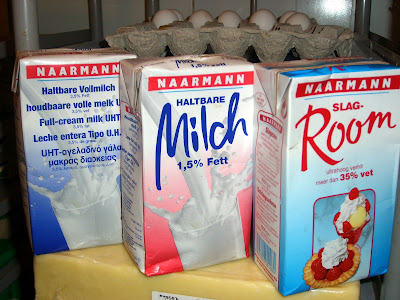
Most of our dairy products don't even need to be kept in a cooler, reefer, or refrigerator. Nope. Its called Ultra High Temp products and after you get used to them, they do quite well.
We buy them by the pallets: Sour Cream, Whole Milk, 2% Milk, cooking cream (with about 2 or 3 version of fat content), whipping cream, etc... Of course our cheese still needs to be refrigerated but that frees up a lot of space until you need it. And refrigerator space is regarded as a vary valuable commodity. Yes, these products taste better or work better once they are chilled, but you can keep them in dry storage on pallets and move them into refrigeration a little at a time.
You probably wouldn't believe the milk we go thru just as an additive to coffee and/or tea...So why refrigerate it just for it to be heated back up? Why use chilled dairy products to build sauces that go out hot? No reason, room temperature is good enough.
Here's a picture of a few of the items:
Sunday, June 8, 2008
Nasty Taco Sauce
Some people who don't know any better will buy this taco sauce and think, 'Man those Americans eat the nastiest stuff' (because I have only seen this stuff in Europe). This IS NOT anything similar to our Taco Sauce except maybe that it has some tomato product in it. On another ship I worked on they ruined 'Mexican Night' by putting this stuff out. Everyone would come along and heap it up on their delicious nachos, tacos, burritos, enchiladas...or whatever, and then it would just ruin the taste of the dish.
On this ship, we specifically asked for NONE of this, but somehow they managed to squeeze it on our container again. But thankfully it's not that much and we just put it out at mealtimes as a 'condiment' not taco sauce.
Maybe you are thinking, 'What's so bad about it?' well let's just look inside the ingredients list and see...
First, it starts off like a simple syrup, sugar first then water. Then, uh-oh, it looks like we are starting to build a sweet BBQ sauce (vinegar, tomato paste, paprika, salt). And then...what the heck is all this stuff? I can make taco sauce from stewed tomatoes out of a can tastier and with way fewer ingredients than this, and certainly NOT using all those particular ingredients.
What's even funnier is that further down the label it says,
'Pictures do not reflect ingredients of this product'
(emphasis mine).
They seriously need to quit insulting people worldwide by calling it 'taco sauce'.
Blah...
Saturday, June 7, 2008
Good Catch
Christian a young boy who we were told is deaf and blind (later we were told that he had cataract surgery last year and now he can see, but it sure didn't seem like it) came in after a nasal oral fistula repair (a hole between is mouth and his nose). When he woke up from anaesthesia he was flailing all over the place. We got his mom to come in and what followed was priceless. She grabbed his hands and put them on her face and put his face up to her neck. She said that the only way he can tell that it is actually her is by her smell and touch. I felt like I was watching the most amazing connection between a mother and son. She is so loving and patient with him as he is inconsolable except by her. Once Christian woke up and was slightly calmed down he went back to the ward.
Later we received Anthony who had surgery on his jaw. At first Anthony was bleeding just a little from his mouth. Then it was more and more. Then we were constantly suctioning. We went into the OR and told Dr. Gary and he came out, took a look, gave us some tips on how to stop the bleeding and went back into the OR and started another surgery. I went to a staff meeting and came back and Wendy was still suctioning poor Anthony. He was awake the whole time and very cooperative. I took over the suction duty again and tried to stop the bleeding with no success.
I went back into the OR and interrupted Dr. Gary during surgery to tell him I was concerned. God bless that wonderful man. He quickly came to Anthony's bedside and looked inside his mouth and saw a sub-lingual hematoma (a collection of blood underneath the tongue a that pushes the tongue back that closes off the airway... bad). He said "Girls, good catch. If we would have waited another 30 minutes his airway could have closed off." I don't think he could have said anything nicer to us. We adore him. For him to give us a verbal pat on the back made it worth it today.
While all of this was going on we had another guy that came back from the OR with a blood pressure of 55/21. His normal is 120/70. Needless to say we were quite busy.
Thursday, June 5, 2008
Sanka Sauce (West African Foods)
This one will be a little hard to explain, well ok, not really. Its just it may be a little hard for you to replicate if you are the kind of person who needs a recipe of exact measurements.
Elements of this sauce are mostly the basics of a lot of stews, palava sauce (althought it can be argued like most everything food can be nowadays as to origin or authenticity), meat sauces, and other soups & sauces of the West African people.
First I will explain that you can't really google (search) for this recipe the name is unique and created by a few West Africans and a North American white boy from southern part of the United States, Alabama & Georgia. Why? Because they didn't know what to call it besides red sauce, which means many different things to many different cultures. And because it was finally nice to make it difinitive in our minds.
First the basics then the story:
Start with oil (red palm oil if you got it) don't be shy, throw in chopped onions, diced/chopped/pressed garlic, saute till translucent. Add chopped bell/sweet pepper (green, red, etc...), fresh ginger, saute about 3-5 minutes longer (med high heat). Add in cayenne or local equivalent hot pepper ( use for amount of heat YOU can stand) tomato paste and some fresh chopped tomatoes. Tomato paste should be a good wooden spoon size dollop to start, more as necessary...fresh tomatoes should be about 5 or 6 roma tomatoes worth (so we are going for a medium size HOME pot worth of sauce). Let simmer, if sauce gets too thick water it down some more and let simmer. They usually let this sauce cook for at least a half hour and up to a full hour or more (depending what meats, fish, chicken feet, egg or other things they may cook in there with it.
And by the way, Chicken feet put out good taste for soups and sauces and if your not shy you can suck off whatever substance (meat & sauce) is left on them when your done cooking, its tasty.
The consistency has been between soup and a sauce most times when I have had it. Spinach and a few other ingredients can been added to make a palava sauce, goat meat for certain stews...it becomes endless the possibilities.
Check your seasonings, salt & pepper as needed, more cayenne or hot pepper? Need more sauce? Add more paste, tomatoes, and/or water (sauce should not take on a sweet taste from the paste, that would be entirely too much).
We (Reuben, Alex, Alex, Joe, Charles, Kafue, Frank...countries represented: Ghana, Togo, Sierra Leonne, etc..), loved the movie Cool Runnings and since it was one of the favorites on our small ship (Caribbean Mercy, now retired) we watched it over and over again when we got bored on a sail. In the story of the jamaican bobsled team that went to the Olympics was a team member name Sanka, and Sanka had a lucky egg. See where I am going with this yet?
Reuben made this sauce most of the time and everyone else stood around telling him how they thought he should be making it. But I think it was safe to say Reuben made it the best and he usually ALWAYS added egg in the sauce, like you would an egg drop soup. Mix egg or at least crack yolk. Drop egg into Sanka Sauce while it was simmering and then just stir around once or twice, then let it cook.
Meat or additional things could be added almost anytime taking into account you simmered the sauce long enough to cook what was in it, or if it was a bean or pea of sorts then it would go in when the fresh tomatoes and paste went in.
Sanka Sauce. Nothing more than the traditional West African red sauce with an egg thrown in, or not! [now maybe after I post this you can google search for Sanka Sauce and it may start coming up. SMILE]
* I am not an authority by any means on West African food or cooking, these are my personal views and experiences as they have happened to me and many of my friends who are from these regions of the world*
Wednesday, June 4, 2008
Favorite Things About Living On A Hospital Ship in Africa
As I sit in the recovery room all by myself awaiting my first patient to come out of the OR I have been thinking about my time here. We have been here for 5 months now. Let's be honest. There have been a couple of days when I was looking for plane tickets to get the heck out of here. And others when all I can do is think about how the Lord has blessed me so much to be here. I guess this reflective mood stems from the decision that Tyrone and I will come home after our 1-year commitment is complete. I don't know where home is. We think we will travel a bit more, maybe take a travel nursing job here and there. We have not made any decisions but we do know that we want to enjoy our time with Mercy Ships as much as possible therefore we want to leave before we become burned out or bitter.
In my time here I have come up with my favorite things about living on a hospital ship in Africa:
1. Short commute to work
2. Friday nights at the snack bar, with music playing and people dancing and chatting. (you'd have to here to understand the true beauty)
3. The patient's first glimpse in the mirror after life-changing surgery.
4. Friendships
5. The things that we do when we are bored: playing in the rain, playing taboo with people from all over the world, just sitting around chatting.
6. This one sounds cheesy but it is truly one of my favorite things about living on the ship. I love to walk down the halls of the ship to where ever we are going, holding Tyrone's hand and knowing that I get to experience this crazy life with my best friend.
7. I love to sit on the dock and watch the sunset and be silly with my girlfriends as we discuss the meaningful things in life like what we would be if we were a superhero.
8. Being a part of our Bible study with our girls at the orphanage, some times I think maybe they are the reason why I am here in Liberia.
9. Taking a shower after being hot and sweaty from the Liberian sun.
10. Sitting at the Starbucks cafe on a day off sipping my hazelnut double shot latte chatting with people as they pass through.
Tuesday, June 3, 2008
Hamburgers (BULK) The Simple Way
Do you get your ground hamburger or minced beef (Europe) in big round tubes? Packed in a cardboard box? Maybe 5 to 10-pound tubes of them frozen solid, or fresh is how they usually come.
First I want to say that YES, if you can mix spices, herbs, or your 'special seasonings/flavors' into your beef, then that is the way to go...A lot of time I do not have this option (I have the option but not the time) so I move on to the next best thing for time, flavor, and mass production at a cheap price instead of paying for pre-patties and wasting a lot of freezer space.
I won't waste a lot of time describing how to do it but rely on my pictures to tell the tale.
If you have a good slicer (commercial or restaurant-grade of course) then set it to the width of the burger you would like, take your defrosted ground burger/minced beef (leaving plastic wrap on), and start slicing your burgers.
Use large cambro's or containers of your choice to layer the hamburger in, we separate our burgers with pre-sized parchment paper that comes in large sheet tray size. For the first layer of the burger put your seasonings, flavors, etc...down in the bottom of the container. Then from there just keep applying it to the top of each layer of burgers. As the weight of the burger and the release of more blood/water happen over a course of time it pushes the flavors down over the rest of the burgers or lends more time for seasoning to dilute and spread. OH! And of course, remember to pull that plastic ring off of the patty!
We just use that wonderful Worcestershire Sauce on each layer.
Later you can move the burgers to large sheet trays and cook them in the oven OR-AND THIS IS WHAT WE DO, sear them on both sides at a high heat poking them in the center on a flat top grill or brazing pan. This releases juices fat/blood in the burger so it doesn't swell up and turn into a meatball!!! Then continue on to layering them on the large sheet pans and finishing them in the oven as slow or as fast as you want to cook them.
The process I wanted to show you here today was more about creating the burger patties quickly with no filler and without wasting money or space by buying pre-made patties.
Pictured here in this post is Ernest from Ghana, one of our Galley Cooking Team Leaders.
Recovery
About 2 months ago I went and talked to my boss Kirstie who is incredible understanding, and told her my feelings about the schedule. I asked to be transferred to Recovery room or anything that had a more normal work hours. She responded with the obvious "We re really short ICU nurses so, no". I knew that would be the response and if I was really honest I know that I would really miss the ward. I would miss the close connections we develop with our patients and I would miss the ICU when we get ICU patients.
On Friday I got an email asking me if I could work in the Recovery Room this week. I did my first shift yesterday and I must admit, it was wonderful. I love Maria and Wendy who will both be here until the out reach is almost over. And I love that once the patient is recovered they go back to their room. It kind of reminds me of the ER.
Sunday, June 1, 2008
The Importance of Red Palm Oil (West African Foods)
The Importance of Red Palm Oil: Let us quickly delve into my favorite online pedia, Wikipedia for a very nice quick run-down of what Red Palm Oil is...
Palm oil is a form of edible vegetable oil obtained from the fruit of the oil palm tree. Previously the second-most widely produced edible oil, after soybean oil, 28 million metric tons were produced worldwide in 2004. It may have now surpassed soybean oil as the most widely produced vegetable oil in the world. It is also an important component of many soaps, washing powders and personal care products, is used to treat wounds, and has controversially found a new use as a feedstock for biofuel.
The palm fruit is the source of both palm oil (extracted from palm fruit) and palm kernel oil (extracted from the fruit seeds). Palm oil itself is reddish because it contains a high amount of beta-carotene. It is used as cooking oil, to make margarine and is a component of many processed foods. Boiling it for a few minutes destroys the carotenoids and the oil becomes colorless. Palm oil is one of the few vegetable oils relatively high in saturated fats (like coconut oil) and thus semi-solid at room temperature.
NOW, lets talk about its importance in West African Cooking...
Frankly, there is no way to substitute it, if you are using West African recipes and they call for Palm Oil or Red Palm Oil make sure you use it! If you can't get it, well that's too bad.
What's so special about it? Have you ever smelled different oils? How about that special extra virgin olive oil you love so much? Remember how you can tell when someone is cooking with it because you smell that 'SMELL' it gives off when it's being heated up? Red Palm Oil is like that, NO, not the taste of Olive Oil...but the distinguishing characteristics of using it.
If you have ever looked at it, smelled it, tasted it (either cold and/or heated up), and/or smelled it heating up...You would never forget it, especially if your food was cooked in it. And then, every time after that you have a dish that should have Red Palm Oil in it, you will miss it and recognize when it's gone. It's distinctive, and it's good. But probably not really healthy, maybe within moderation.
Alright, we'll see you again next with SANKA SAUCE...
* I am not an authority by any means on West African food or cooking, these are my personal views and experiences as they have happened to me and many of my friends who are from these regions of the world AND as I have worked with them and learned from them…*
Friday, May 30, 2008
Ice Cream in Liberia (Häagen-Dazs)
Here in Liberia, Ice cream is definitely a luxury...or at least this brand is! (Click for a closer look!)
That's right folks, it's $25 twenty-five dollars, United States Dollars!!!
Credit to finding-joy.blogspot.com for the picture
Banku and Kenkey (West African Foods)
As a follow-up or continuation of a previous post (Sea Monkey & Fufu), we will discuss Banku & Kenkey.
Banku and Kenkey are two more Fufu-like staples from Western Africa, served with a soup, stew, or sauce. They are particularly popular in Ghana. Both are usually made from ground corn (maize), although most of the Ghanaian people I have met say that only Banku is made from a mixture of maize and grated Cassava tuber. Kenkey is usually just the corn (maize).
Making Banku or Kenkey involves letting the maize (or maize and cassava tuber) ferment before cooking. Banku is cooked in a pot using hot water to make a smooth whitish consistent paste; Kenkey is partially cooked, then wrapped in banana leaves, maize or corn husks, or foil, and steamed.
Personally, I prefer the Banku. A few times now we have gone to a local ‘Ghanaian Restaurant’ here in Liberia where I have enjoyed the Banku several times (along with goat and chicken, okra stew, and ground pea soup (a soup made from ground peanuts, like unsweetened peanut butter), the Fufu is good, but I have had way more Fufu over the years than I have had Banku or Kenkey.
Notice the water basin and liquid soap in the picture? (curtesy of Atidekate)- food is eaten with the hands, Ghanaians are usually meticulous about carefully washing their hands before and after a meal. There’s a bar of soap or bottle of liquid soap on every table at the Ghanaian Restaurants I have been in.
Want to try out some Banku, Fufu, or other products? Scout around on the internet. Back home we had a large (more than one) Asian food store that had a West African aisle with a lot of products I am covering in these posts. May not be quite the same, but it will get you close, and sometimes just the memories of eating a particular food bring you back to that time and place.
Next addition we will cover the importance of RED PALM OIL and not trying to substitute it with other oils when making West African recipes. ITS NOT THE SAME!
Which will help bring me around to the Sanka Sauce and all its derivatives: Ground Pea Soup, Okra Stew, and other sauces…(like Palava).
* I am not an authority by any means on West African food or cooking, these are my personal views and experiences as they have happened to me and many of my friends who are from these regions of the world AND as I have worked with them and learned from them…*
Thursday, May 29, 2008
Sea Monkey and FuFu (West African Foods)
*Sea Monkey* according to my Monrovia friends is a large fish (closely related to tuna or dolphin/or may even be tuna or dolphin - this is speculative) That is very dark in color and bloody.
And just to confirm it I asked our ward cook Ophelia who said, and I quote: “A very dark meat, from a big fish…like dolphin…”.
I thought it would be interesting to some of you out there because in all reality you have probably already ate Sea Monkey and never knew it!
Oh! You say what about Fufu? I often forget about all these things as I have had a couple of ‘right hand man’ in the kitchen usually from West Africa since I started with Mercy Ships in 2001 on the Caribbean Mercy…Ok, let me delve into a small lecture on that one.
Fufu, or fu fu, is a staple food of West and Central Africa. It is a thick paste or porridge usually made by boiling starchy root vegetables in water and pounding with a large mortar and pestle until the desired consistency is reached. [this is basically true and was derived from wikipedia online...now let me deviate to what I personally have found is true in my experience]
In Western Africa, Fufu is usually made from cassava not yams (or at least parts I know something about, like Liberia, Ghana, Benin, Sierra Leone…although the one mixed with plantain seems to be a one of choice among my friends too) sometimes combined with cocoyam, plantains, or maize. In a later post we will get into Banku and Kenkey which are usually fermented before cooking (these are made from the corn maize). The Liberian Dumboy is made from cassava flour.
Often, the dish is still made by traditional methods: pounding and beating the base substance in a mortar with a wooden spoon. Places where poverty is not an issue, or where modern appliances are readily available, a food processor may also be used. Although be ready for scorn because as you may find out, purist do not believe in real Fufu love made in the processor. But if you make it without the processor It will quickly where your arm out making it for more than 4 people!
In Western and Central Africa, the more common method is to serve a mound of Fufu along with a sauce made from okra, fish, tomato, etc…(which we, Reuben & I renamed it Sanka Sauce years ago ~ more about that in another post) because the sauce has variations and can go by so many names. You pinch off a small ball of Fufu and make an indentation with the thumb. This “bowl” indentation is then filled with sauce, and the ball is eaten. In Ghana and Nigeria, the ball is often not chewed but swallowed whole. In fact, among the older generation, chewing Fufu is frowned upon/not accepted.
So for now ~ “to be continued…” as we cover the upcoming topics of Banku, Kenkey, & Sanka Sauce.
* I am not an authority by any means on West African food or cooking, these are my personal views and experiences as they have happened to me and many of my friends who are from these regions of the world*
Wednesday, May 28, 2008
Galley work increases, Staffing Fluctuates
On my end, the days started getting long last week when we found out the crane for lifting our trash out of the kitchen (because we use big metal bins, you have to imagine a lot more trash from dining room and galley than those few bags you have at home) would be out of service till it could be fixed (and no one was available to do it over the weekend apparently). Hopefully they say it will be done by tomorrow.
We now have our vision trips starting to come to the ship. We also had 2 days of Pastors Conferences on board (Liberian pastors just in case there is some confusion). Both of these combined made plenty of extra work in the form of small lunches and dinners and planned meals for the pastors conference, special meetings, and vision trip people along with the feeding of the regular crew. AND to top it all off actual galley crew staffing is low.
[What is a Vision Trip? Simple answer: Mercy Ships vision trips are one week (maybe longer?) trips intended to give a small number of people a very detailed first hand view (on location, on the ship) of the ministry.]
But I do need to mention (for all the Tyler folks, but not to upset our Grace Community Church friends in Young Marrieds...) that we have had the pleasure of 5 hard workers from Green Acres Baptist Church working in our dining room and galley this past week, so that has DEFINITELY helped us out! Thank You! (here is a post from the Green Acres Pastor's blog - Pastor David Dykes)
I am now sitting at a small table in the 'cafe' area finally getting a little time off to relax and post this blog...while sipping on my chocolate mint latte. Stephanie is off for Bible study with the girls at a local orphanage (she's blogged about it in earlier posts).
Friday it will be the one year celebration of the 'Passing of the Torch' last year when I was recruited for the Maiden Voyage of the Africa Mercy when the retired Anastasis "transferred" over to the Africa Mercy - ..."Passing of the Torch" ceremony on board when the torch was passed from crew member to crew member starting from the top of the gangway of the Anastasis to the top of the gangway of the Africa Mercy.
We will have activities and dinner on the dock for all of this on Friday evening...so hopefully if all goes well BBQ Ribs, Chips/Fries, Baked Beans...coleslaw? rolls, etc...
Monday will bring another small luncheon for guests, separate from the rest of the crew and then, well, it just keeps going. Functions, special events, special meals, the daily feeding of the crew as usual.
Stephanie and I are doing great! But then again she is back on nights so there may be a 'grump' throw down (or fight for those of you who may not know this term) later this week to see who has the right to be grumpier and complain more from all the work we are doing...and whose working the hardest, and why we should be more sensitive to each other because we both tend to start feeling selfish. (this is a usual skirmish at the end of spells of night shift or hard working schedules, but nothing to be alarmed about) But Stephanie does tend to get mad when I laugh about it because I can almost predict it coming!
Well, just as a funny side note we are almost out of cheese and ice cream (for the whole ship)...but hey, I'd rather sacrifice that than my coffee!
[I know, I know, you are probably saying "YOU GOT ICE CREAM?!?!?"]
Tuesday, May 27, 2008
Busy Body
We have acquired a galley person in the salads section, and a 'loaner' from crew services...and from time to time I can talk my old (she's young) friend Tatyana from Brazil into doing a little galley work if she can get a babysitter! She used to work with me on another ship years ago, but has since become a mother and has more important priorities (no, not her husband, her other child!)
We have come to an end of the pastors conference, and soon to be finished vision trips (although its just temporary till the next one comes)...as the whole crew eats African food for African Night. And later after the dining room is cleaned quickly we refill for another 60 to 75 dinner guests with a church group that came to 'check us out'. They also are have the African Dinner.
What have all these 'African Dinners' consisted of? Besides West African style foods here is a more specific list:
Spicy baked/roasted chicken, with one of the following: peanut sauce, red sauce, palava sauce...
Rice / Jollof Rice
Spicy Black Eye Beans (black eyed peas, red palm oil, local peppers...)
Eggplant (skin, cube, saute with onion, garlic...later add tomato product like sauce, stewed, or past continue to cook)
Fried Plantains
Cassava/Potato Greens
The ward cook had a tasty looking dinner cooked for the patients yesterday made out of diced chicken, pumpkin, and of course a spicy tomato and red palm oil base.
This food is definitely high starch and not low fat...at least by Western standards.


